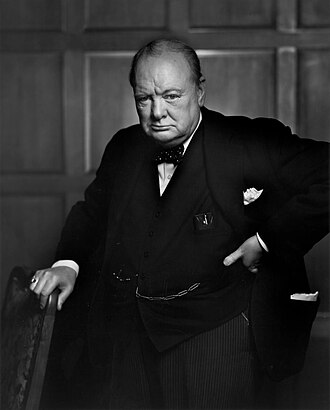
Your Life Path
Every number in this reading comes from one of two places. Your Life Path — the spine of the chart, the number everything else is read against — comes from your birth date: the digits of 30 November 1874 added together and reduced to a single figure, which in your case is 7. The other core numbers come from your birth name, Winston Leonard Spencer Churchill, with each letter assigned a value from 1 to 9 and the totals reduced the same way: all the letters for the Expression, the vowels for the Soul Urge, the consonants for the Personality. That is the whole method. Nothing here is guessed; each figure can be traced back to the date or the name.
A Life Path 7 (the birth date reduced — the spine of the chart) describes a mind that needs to understand a thing before it will trust it. The 7 does not take the offered explanation. It goes away, turns the matter over, tests it against what it already knows, and comes back only when the account holds together. That going-away is not aloofness; it is how the 7 does its work. Solitude is not a retreat from the task but the room where the task gets done.
Two textures follow from this. One is a strong inner life running in parallel with whatever is happening outside — a second conversation, quieter than the first, that is always weighing and doubting. The other is a particular relationship with certainty. The 7 is skeptical by construction, and the skepticism turns inward as readily as outward. It can hold a position with great force and still, privately, be interrogating it.
The costs are real. A 7 can keep its own counsel past the point where counsel should be shared. It can withdraw precisely when the situation calls for approach, and then read the resulting distance as proof that approach would have been pointless. It can mistake the pleasure of analysis for the completion of a decision. And because it works by retreat, it is prone to a loneliness it half-chooses and then resents. Looking back, you may find that your most productive stretches were preceded by periods when you were hard to reach — reading, walking, writing, sitting with something — and that the silence was not idleness but the first half of the work.
None of this is a verdict on what you have done or will do. A 7 describes the grain of the wood, not the shape of the furniture. What you build with it has always been yours to decide.
There is a second number that comes from the date rather than the name: your Birthday number (simply the day of the month you were born, read on its own). You were born on the 30th, which resolves to 3, and the 3 sits alongside the 7 as a distinct emphasis rather than a second spine. Where the 7 withdraws to think, the 3 is the capacity to put the thinking into words — phrasing, timing, the well-placed sentence, humor as a tool rather than a decoration. A 7 with a 3 Birthday is an analyst who can also say it out loud, and say it well. The 3's cost is scatter: facility with words can run ahead of the thought behind them, and the pleasure of the phrase can become its own justification. But as a companion to a 7 it gives the inward number an outlet, and keeps the analysis from staying locked in the room where it was made.
The Numbers In Your Name
Three numbers come from your birth name, and they answer three different questions. Your Expression number (every letter of the birth name added together) describes what you are built to do — the equipment you were issued. Your Soul Urge (the vowels only — what you want when nobody is asking) describes the private want underneath the equipment. Your Personality number (the consonants only — the layer you lead with before the rest of you arrives) describes the surface. Read together, they show where equipment, want and surface agree, and where they pull against each other. In your chart the pulling is the interesting part. One preliminary note: every digit from 1 to 9 appears somewhere in your birth name, so the chart names no missing quality that has to be learned from nothing.
Your Expression (all the letters of your birth name — what you are built to do) is 6. A 6 in this position is built for responsibility: the care of a household, an institution, a group of people who depend on someone keeping the structure standing. The 6 notices what needs doing and assumes, often without checking, that the doing is its job. It holds standards — for itself and, less comfortably, for others — and it carries. That is its equipment: the capacity to take on a load and keep it, to be the one who remains when the work is unglamorous. The cost is over-assumption. A 6 takes on more than was asked, manages what was not its to manage, and then feels the weight as a grievance it never quite voices. It can also confuse being needed with being right.
Set this beside your Life Path 7 (the birth date reduced — the spine of the chart) and the first friction appears. The 7 needs to go away and think; the 6 is built to stay and carry. The 7 trusts only what it has tested alone; the 6 is issued for service to others, which rarely waits for the testing to finish. This is a genuine tension, not a contradiction to be resolved: a private analyst built for public duty. You may have felt it as the pull between the room where you think and the room where you are wanted, and possibly as guilt in whichever room you chose.
Your Soul Urge (the vowels of your birth name — what you want when nobody is asking) is 4, and it arrives through 13. A 4 in this position wants solid ground. It wants order, method, something built that holds its shape after you have stopped holding it. It wants the work to be real — measurable, durable, finished — and is uneasy with anything that floats. For a 7 whose mind lives in analysis and a 6 whose equipment is care, this want for concrete structure is the anchor: the part of you that is not satisfied by understanding a thing or by looking after it, but needs to have made something out of it.
The 13 behind that 4 needs careful handling, so let me be plain about what it is and is not. The system calls 13 a Karmic Debt number — its term for a total that reduces to a core number but carries extra load in one particular area. It is not a penalty, not a record of anything done wrong, and not a debt in any moral sense. It is a pattern. The 13 pattern is that work in the 4 area — structure, follow-through, building — tends to feel heavier than it should, and the temptation to shortcut is correspondingly stronger. It is the experience of doing a thing quickly, watching it not hold, and having to do it again the slow way. Its deliberate handling is method: routine, sequence, finishing what is begun, taking the plain route over the elegant one. The load is real, but it is a load in one area, not a judgment on the whole.
Your Personality number (the consonants of your birth name — the layer you lead with) is 2. This number is not who you are but what you offer first. A 2 leads with reception: waiting, listening, reading the temperature of the room before entering it, giving way before pressing. It is diplomatic by reflex and understated by preference, and it tends to make itself smaller at first contact than the rest of the chart warrants. This is where the second friction lives. Underneath the 2 surface is a 7 interior that has already decided what it thinks, a 6 that intends to carry the whole thing, and a 4 want that intends to build it. The result is a habit of leading with deference and then, some way in, turning out to have been steering all along. You may have noticed that your first move in any new situation is to hold back, and that the holding back is not shyness so much as reconnaissance.
A third friction is worth naming. Your Soul Urge 4 (the vowels — what you privately want) wants solid ground, and your Birthday 3 (the day of the month — the 30th, resolving to 3) is a gift for language, which is the least solid material there is. Words move; they are heard differently by different listeners, they date, they can be turned. A 4 want housed in a 3 talent is the desire to build something permanent out of a medium that is by nature provisional. The resolution, if there is one, is that language becomes permanent only when it is worked like stone — drafted, cut, rebuilt — which is the 13 pattern again, showing up in the one place you might have expected it to be easy.
Where The Name And The Date Meet
Your Maturity number (the Life Path 7 from the date added to the Expression 6 from the name — the direction the chart resolves toward in the second half of life) is 4, and it too arrives through 13: 7 plus 6 is 13, and 13 reduces to 4. This is worth pausing on. The same 13 that sits behind your Soul Urge (the vowels — your private want) appears again here by an entirely different route, from the date and the whole name together rather than from the vowels alone. Two independent calculations land on the same figure. In a chart this is not a coincidence to be explained but a pattern to be noticed: the 4-through-13 texture is not confined to what you want; it is also where the chart as a whole is headed.
The Maturity number (date plus name — the second-half direction) describes not a destination but a settling. In the first half of life the core numbers pull in their separate directions and the person lives inside the pulling. In the second half a direction tends to emerge — not because the tensions vanish but because the person has, by then, found which one they keep choosing. A 4 Maturity says the settling is toward work: structure, method, things made rather than things understood or things cared for. The 7 (the birth date — the analyst) does not stop analyzing and the 6 (all the letters — the carrier) does not stop carrying, but the resolution of the two is neither more thinking nor more carrying. It is building. The analyst and the caretaker meet in the workshop.
With 13 behind it, the building has a specific character. Extra load in the 4 area, a strong pull toward shortcuts, the thing that must be redone properly — this means the second half of life tends to be marked by rebuilding as much as building. Structures made earlier are found not to hold and are made again. Methods that seemed adequate are replaced by slower ones. This is not failure; it is the texture of the number, and it asks for the same handling as before: routine, sequence, finishing.
The tension between your Life Path 7 (the birth date — the need to understand alone) and your Expression 6 (all the letters — the equipment for service to others) is the central tension of this chart, and the Maturity 4 (date plus name — the second-half direction) is where it resolves. A 7 can spend a life understanding without producing. A 6 can spend a life carrying without producing. The 4 says: produce. Make the thing. Whether or not it is understood perfectly, whether or not it serves everyone it should — make it, and then make it better. That is the direction the chart has been settling toward since roughly the midpoint, and at 90 you have a long stretch of second-half history to test it against.
Your Four Pinnacles
A Pinnacle is a chapter of life in which one particular texture comes forward — not a task you are assigned and not an event that is scheduled, but an emphasis that colors the years it covers. There are four, derived from the birth date, with age ranges fixed by the Life Path (the birth date reduced). You are in the fourth now.
Your First Pinnacle (the chapter running from birth to age 29) is a 5. The 5 texture is movement: change, variety, appetite, risk, the pull toward the next thing before the current thing is finished. It is the number of the door that is always slightly open. For a 7 Life Path (the birth date — the analyst who needs stillness to work) this is an unsettling chapter to begin in, because the furniture keeps moving. For a Soul Urge 4 (the vowels — the private want for solid ground) it is doubly unsettling: the years in which the want for stability first forms are the years in which stability is least available. The 5's gift is range — exposure to more kinds of experience than a settled chapter would offer. Its cost is that nothing gets finished.
Your Second Pinnacle (the chapter running from age 30 to 38) is also a 5. The same texture, a second time. The chart does not move on: nine more years of movement and open doors, with the want for solid ground now fully formed and fully frustrated. A repeated Pinnacle (a chapter's emphasis, returning) tends to feel from inside like being told something twice — the first time as circumstance, the second as a question about whether you understood it. A 7 (the birth date) living through a second 5 chapter has usually learned to carry its stillness with it rather than waiting for the world to provide it. The 5 does not let you settle; it asks whether you can think while moving.
Your Third Pinnacle (the chapter running from age 39 to 47) is a 1. After eighteen years of 5, the texture changes sharply. The 1 is independence: initiative, self-direction, standing on one's own judgment without the support of consensus. It is the number of the first step, taken alone. For a chart whose Personality (the consonants — the layer you lead with) is a 2 that defers and waits, a 1 Pinnacle is a chapter that stops rewarding the deferral. And for the 7 (the birth date) whose analysis has by now been tested across two chapters of upheaval, the 1 offers something the 5 did not: the standing to act on what has been understood. The cost of a 1 chapter is isolation of a different kind than the 7's — not chosen retreat but the loneliness of the position no one else is holding.
Your Fourth Pinnacle (the chapter running from age 48 onward, with no end date) is a 4, and this is the chapter you are in now. At 90 you have been in it for more than four decades — longer than the first three chapters combined. The 4 texture is work: structure, foundations, method, endurance, the slow assembly of things that last. Notice what has converged here. Your Soul Urge (the vowels — your private want) is a 4. Your Maturity number (date plus name — the second-half direction) is a 4. And the longest chapter of your life is also a 4. Three 4s from three separate calculations, all landing on the same stretch of years. Whatever you privately wanted, whatever direction the chart was settling toward, and whatever the years themselves emphasize — all of it, since 48, has pointed at the same thing: building.
The 13 behind the Soul Urge 4 and the Maturity 4 gives this chapter its weight. A long 4 Pinnacle with 13 in the chart is a chapter of rebuilding — of finding that the shortcut did not hold and taking the plain way instead, of returning to work that was thought finished. It is heavy, and the pattern asks for deliberate handling, routine and sequence, rather than force.
Your Challenges
A Challenge is a recurring friction across the same periods as the Pinnacles (the four chapters above) — a rub that keeps coming back, sharpening something each time. It is not a flaw in you and it is not a punishment for anything. It is a place where the grain of the chart runs against itself and a certain kind of edge gets worn on. Two of yours are 0, and a 0 Challenge is a real value with a real meaning, which I will come to.
Your First Challenge (the friction running from birth to age 29) is a 1. The 1 friction is about will: how much to assert, and when. It shows up as either pushing too hard — insisting, dominating, refusing to yield — or not pushing at all, deferring to whoever is louder and then resenting it. The person carrying a 1 Challenge tends to swing between the two, and the sharpening comes from finding the calibration. In a chart with a 2 Personality (the consonants — the layer you lead with, which defers by reflex) and a 7 Life Path (the birth date — the analyst who has privately decided), the swing is built in: the surface holds back, the interior has made up its mind, and the friction is the gap between them. Set against a 5 First Pinnacle (the chapter from birth to 29 — movement and change), the 1 Challenge in these years is the friction of establishing any standing at all while the ground keeps shifting.
Your Second Challenge (the friction running from age 30 to 38) is also a 1. Like the repeated 5 Pinnacle across the same years, this is the same friction returning for a second pass. The calibration of will — too much, too little — comes up again, now with more at stake and with the 5 (the chapter from 30 to 38 — still moving) still providing no stable footing to assert from. A second 1 Challenge tends to be the period in which the swing stops feeling like something done to you and starts being recognizable as something you do.
Your Third Challenge (the friction running from age 39 to 47) is 0. A 0 Challenge is not a missing entry. It means that in this period the chart names no single fixed obstacle — no one friction is assigned. At first that sounds like relief, and in one sense it is: nothing specific is grinding against you. But the 0 brings its own texture, which is diffuseness. When no one difficulty is assigned, all of them are available, and the friction becomes the choosing. There is no external edge being worn on you; if you want an edge you have to supply the stone yourself. Set against a 1 Third Pinnacle (the chapter from 39 to 47 — independence, standing alone), the 0 Challenge means that in exactly the chapter that asks you to stand on your own judgment, the chart offers nothing pushing back to define the standing against. The independence is real and unresisted, which is a harder thing to handle than it sounds.
Your Fourth Challenge (the friction running from age 48 onward) is also 0, and it is the one you are in now. For more than forty years the chart has assigned no fixed obstacle. Read against the 4 Fourth Pinnacle (the chapter from 48 onward — building, structure, endurance) and the 13 behind your Soul Urge and Maturity (the extra load in the area of work and follow-through), this has a specific consequence. The 13 pattern asks for method and routine, and method is easiest to keep when something is pushing against it. A 0 Challenge removes the pushing. The risk of a long 0 alongside a 13 is that without an external edge the work goes slack — or, in the other direction, that obstacles get invented so there is something to sharpen on. The handling is the same as it has been: supply your own structure, because the chart is not supplying it for you. Which you choose, and whether you choose, remains entirely yours.
Your Life Cycles
The three Life Cycles are a second timing layer, cut differently from the Pinnacles (the four chapters above). Each Cycle is drawn from one part of the birth date — the month for the formative years, the day for the productive years, the year for the harvest — and describes the background climate of a long stretch rather than the foreground emphasis.
Your Formative Cycle (the background climate from birth to age 29) is 11, which reduces to 2 but is held as a Master number. I want to be precise about what that means, because Master numbers are easily misread. An 11 is not a rank and not a compliment. It is a 2 — relation, sensitivity, receptivity, the tendency to feel what is in the room — with more voltage running through the same circuit. The 11's gift is heightened perception: more input arrives, more of it registers, patterns are noticed that a plainer 2 would miss. The 11's cost is what that voltage does to the wiring. Tension, overstimulation, the sense of being flooded, difficulty settling — these are the 11's ordinary weather, not its failures. An 11 Formative Cycle describes a childhood and young adulthood with the sensitivity turned up past comfortable, for a 7 Life Path (the birth date — the analyst who needs quiet to work) who was therefore receiving more than could be processed in the time available. Layered under a 5 First Pinnacle (the chapter from birth to 29 — constant movement), it describes a beginning that was intense, unsettled and hard to get a footing in. Someone with an 11 here is not more evolved than someone with a plain 2. They have been carrying more current, at a cost, since before they could choose to.
Your Productive Cycle (the background climate from age 30 to 56) is 3. The 3 is expression — language, creativity, sociability, the outward flow of what was inward. It shares its number with your Birthday (the 30th, resolving to 3), so the middle of your life doubled the emphasis on words that the date already carried. This is the cycle during which the 7's analysis (the birth date — the interior) and the 3's facility (the day of the month — the outlet) were most closely aligned: what was thought could be said, and the saying was the work. The 3's cost, here as everywhere, is scatter — fluency outrunning substance. A 3 background under a 1 Third Pinnacle (the chapter from 39 to 47 — independence) and the first years of a 4 Fourth Pinnacle (from 48 — building) describes words used first to establish a position and then to build with.
Your Harvest Cycle (the background climate from age 57 onward) is 2, and it is the cycle you are in now; at 90 you are 33 years into it. The 2 is the plain version of the 11 you began with — relation, cooperation, patience, the supporting role, the detail rather than the outline, being alongside rather than in front. After a 1 Pinnacle (the chapter from 39 to 47 — standing alone) and under a long 4 Pinnacle (the chapter from 48 onward — the work), a 2 Harvest asks for a different posture from the one the middle of life rewarded. Not the first mover but the partner; not the one who decides but the one who is consulted; the quieter role, held with patience. For a 7 (the birth date — the analyst who keeps its own counsel), a 2 climate can be a relief — the pressure to lead is off — and also a loss, because the 7 does not easily accept a supporting voice on questions it has thought harder about than anyone else present. The 2's gift in a harvest is that it turns what was built toward others: the structures of the 4 chapter become things held in common rather than things held alone.
This Year
Your Personal Year (the texture of a single calendar year, calculated from your birth month and day added to the current year) for 1965 is 8. The 8 is the number of accounting in the widest sense: authority, resources, consequence, scale, the weighing of what has been built against what it cost. An 8 year tends to bring matters of stewardship to the front — not as events but as questions. What is held, and by whom? What is worth what? Where does responsibility actually sit, as opposed to where it is assumed to sit? The 8 is not sentimental about any of this. It measures.
For a chart with a 4 Maturity through 13 (date plus name — the second-half direction toward building, with extra load) and a 4 Fourth Pinnacle (the chapter from 48 onward — the long work), an 8 year has the texture of stocktaking. It tends to ask for an honest reckoning of the structures: which hold, which were built on the shortcut and need the plain way, which are ready to pass into the shared keeping that the 2 Harvest Cycle (the climate from 57 onward — partnership, the supporting role) emphasizes. The 6 Expression (all the letters — the equipment for responsibility) tends to feel an 8 as a demand for accountability and to answer by wanting to carry more; the 8's counter-pressure is to carry precisely and no more. The 7 (the birth date — the analyst) tends to meet an 8 year by withdrawing to think about the reckoning rather than making it, and the year's texture keeps returning the question until it is answered in the open.
None of this forecasts anything. An 8 year does not bring or take. It changes the light, so that questions of weight and consequence are easier to see and harder to leave alone. What is done with that light is a matter of choice, as it has been in every other year.
Living With These Numbers
A chart is a pattern language. It describes tendencies and recurring dynamics, not outcomes, and it is only useful if you can check it against what actually happened. Here are four things this chart suggests, offered for testing rather than belief.
The first is the retreat-and-return rhythm. A 7 Life Path (the birth date — the analyst) with a 3 Birthday (the day of the month — the gift for words) tends to produce its best work in two strokes: a period of withdrawal, during which nothing visible happens, followed by a period of unusually fluent output. If you look back at the moments when the words came most easily, you may find that each was preceded by a stretch of silence. The pattern suggests the silence was preparation, and that trying to skip it tends not to work.
The second is the rebuilt thing. The 13 behind both your Soul Urge (the vowels — what you privately want) and your Maturity number (date plus name — the second-half direction) describes a recurring experience: something done quickly, found not to hold, and done again the slow way. It is worth asking whether the structures in your life that have lasted longest are the ones that were built twice. If so, that is the 13 handled well — not the absence of the shortcut but the return from it.
The third is the shape of the timeline. Two 5 Pinnacles (the chapters from birth to 38 — movement and change) followed by a 1 (the chapter from 39 to 47 — standing alone) and then a long 4 (the chapter from 48 onward — building) describes a life whose first four decades were mobile and whose remaining decades were spent making things that hold. A Soul Urge 4 (the vowels — the private want for solid ground) present all along means the want for stability predated its availability by some thirty-eight years. You may recognize the frustration of that gap, and the relief when the chapter finally changed.
The fourth is deferral, then assertion. A 2 Personality (the consonants — the layer you lead with) over a 7 interior (the birth date — the mind already made up), passing through two 1 Challenges (the frictions from birth to 38 — the calibration of will) and a 1 Pinnacle (the chapter from 39 to 47 — self-direction), describes a habit of holding back first, by reflex, and then moving with a decisiveness the opening did not advertise. The test is whether your first response in a new situation has consistently been quieter than your eventual one.
Every one of these is a tendency, not a rule. The numbers describe the grain; the cutting has always been yours.